
In this data-backed report, you’ll learn how big the handmade market really is, which regions and categories are driving growth, where the industry is headed through 2033, and the trends that will shape the future of handmade products.
Table of contents
- Handmade Market Size: Key Statistics
- Global Handmade Market Size
- U.S. Handmade Market Size
- Handmade Market Size by Region
- Global Handmade Market Size by Category
- US Handmade Market Size by Category
- Handmade Market Growth Drivers
- Handmade Market Trends (2026)
- Handmade Market Restraints
Handmade Market Size: Key Statistics
- The global handmade market is worth an estimated $1.28 trillion in 2026 and is expected to reach $1.47 trillion by 2033.
- The global handmade industry is growing at a 2.0% CAGR between 2026 and 2033.
- The U.S. handmade market is worth an estimated $343 billion in 2026, making up around 27% of the global market.
- Asia-Pacific is the largest handmade market region with a 45.1% share, generating $578 billion in 2026.
- North America is the fastest-growing major region with a projected 3.0% CAGR from 2026 to 2033.
- Home decor, furniture, and woodwork are the largest handmade category worldwide, with a market size of $347 billion in 2026.
Global Handmade Market Size
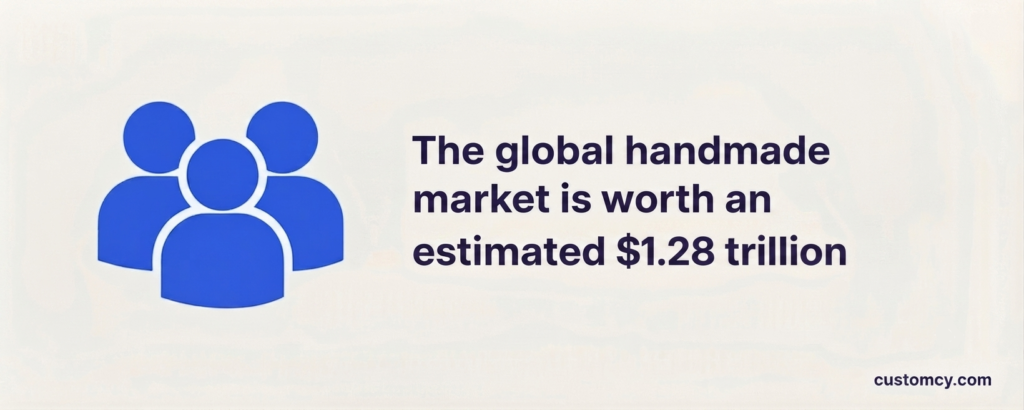
The global handmade market is worth an estimated $1.28 trillion in 2026. And it’s still growing. By 2033, the market is projected to reach $1.47 trillion. That represents a steady 2.0% compound annual growth rate (CAGR) between 2026 and 2033.









U.S. Handmade Market Size

The U.S. handmade market is estimated to be worth $343 billion in 2026. The market is expected to continue growing over the next several years, reaching $422 billion by 2033. This represents a healthy 3.0% compound annual growth rate (CAGR) between 2026 and 2033.
Handmade Market Size by Region
The Asia-Pacific region dominates the global handmade market. In 2026, it accounts for 45.1% of the world’s handmade industry.
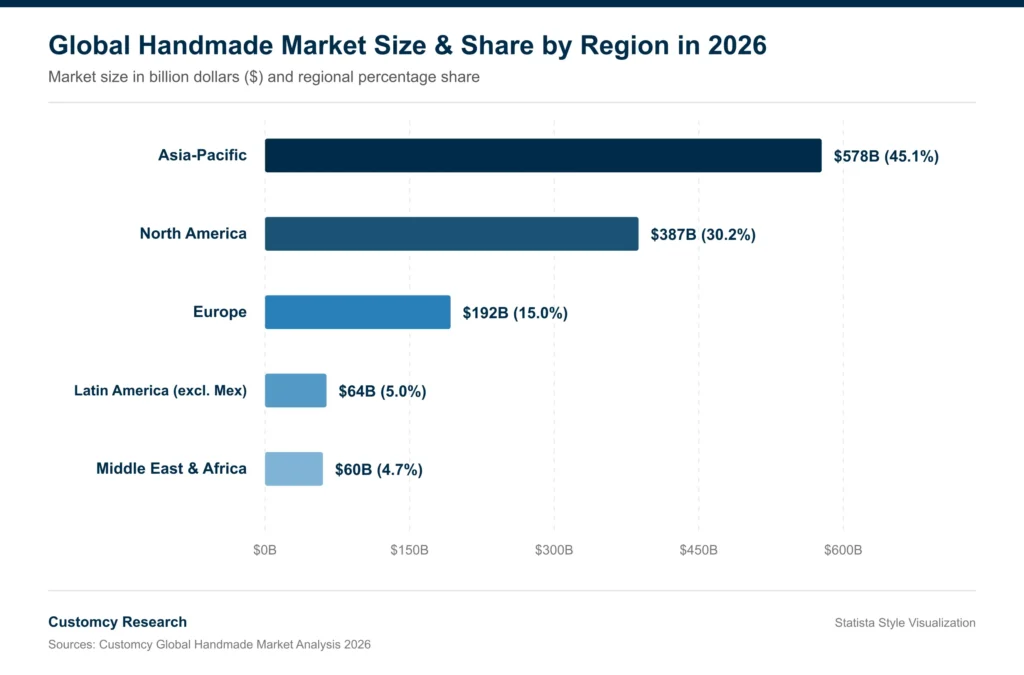
North America ranks second with 30.4% of the global market, followed by Europe at 15.0%. Together, these three regions represent more than 90% of the global handmade market, showing just how concentrated the industry is.
| Region | 2026 Market Size | Share of Global Market | 2033 Market Size | CAGR (2026–2033) |
| Asia-Pacific | $578B | 45.1% | $621B | 1.0% |
| North America | $390B | 30.4% | $478B | 3.0% |
| — United States | $343B | 26.7% | $422B | 3.0% |
| — Canada | $33B | 2.6% | $39B | 2.5% |
| — Mexico | $14B | 1.1% | $17B | 2.4% |
| Europe | $192B | 15.0% | $226B | 2.3% |
| Latin America (excluding Mexico) | $64B | 5.0% | $78B | 2.8% |
| Middle East & Africa | $60B | 4.7% | $72B | 2.6% |
| Global Total | $1,283B | 100% | $1,474B | 2.0% |
Asia-Pacific’s growth is slower despite its massive size. The region is projected to grow at just a 1.0% CAGR through 2033. In other words, Asia-Pacific’s advantage comes from its enormous market size rather than rapid growth.
Global Handmade Market Size by Category
Home decor, furniture, and woodwork make up the largest segment of the global handmade market. In 2026, this category is worth $347 billion, representing 27.0% of the entire market.
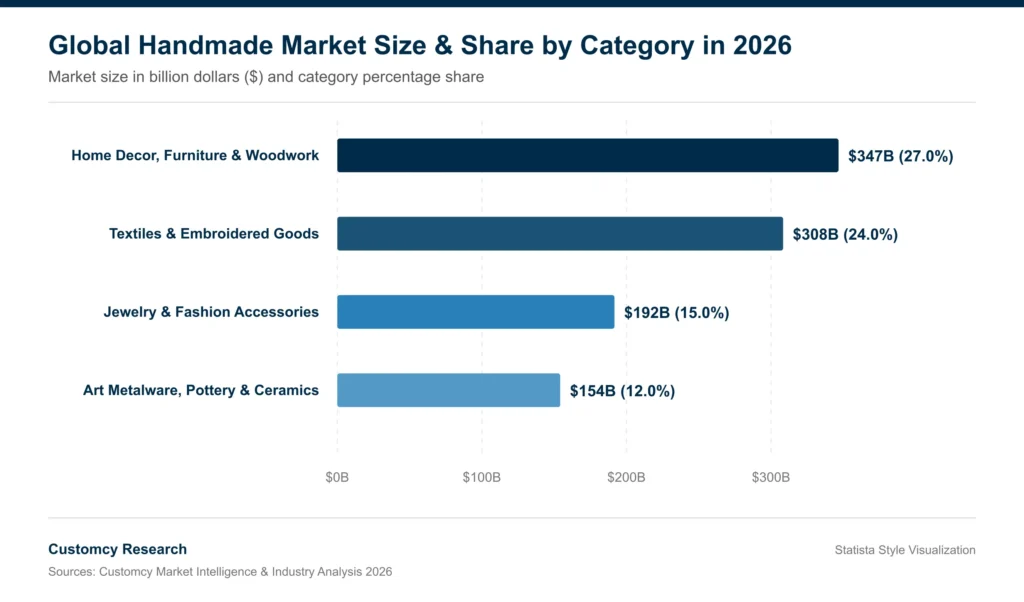
Meanwhile, textiles and embroidered goods account for another 24.0%, while jewelry and fashion accessories contribute 15.0%. Together, these three categories generate more than 66% of all handmade sales worldwide.
| Category | 2026 Market Size | Share of Global Market | 2033 Market Size | CAGR (2026–2033) |
| Home Decor, Furniture & Woodwork | $347B | 27.0% | $379B | 1.3% |
| Textiles & Embroidered Goods | $308B | 24.0% | $333B | 1.1% |
| Jewelry & Fashion Accessories | $192B | 15.0% | $230B | 2.6% |
| Art Metalware, Pottery & Ceramics | $154B | 12.0% | $172B | 1.6% |
| Craft Supplies & Tools | $128B | 10.0% | $155B | 2.7% |
| Toys, Games, Paper & Other | $154B | 12.0% | $205B | 4.2% |
| Global Total | $1,283B | 100% | $1,474B | 2.0% |
The Toys, Games, Paper & Other category leads with a 4.2% CAGR, followed by Craft Supplies & Tools (2.7%) and Jewelry & Fashion Accessories (2.6%). Much of this growth is being driven by e-commerce, DIY hobbies, custom gifts, and demand from younger consumers.
US Handmade Market Size by Category
Home & Living is the largest handmade category in the United States. In 2026, it generates $115 billion, accounting for 33.5% of the entire U.S. handmade market.
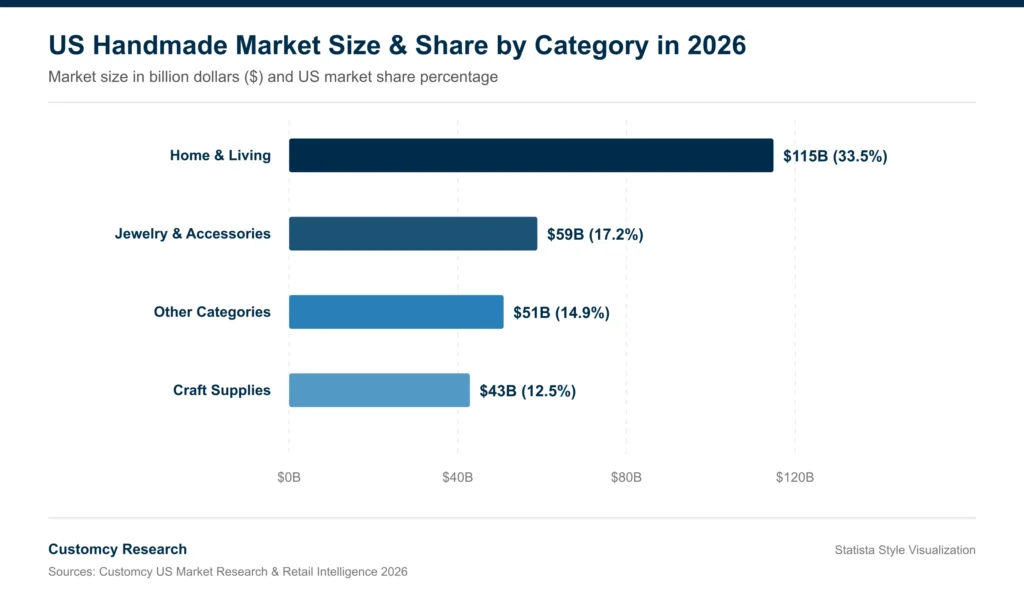
Jewelry & Accessories ranks second with 17.2% of the market, followed by Other Categories (14.9%) and Craft Supplies (12.5%). Together, these four categories make up more than 78% of all handmade sales in the U.S.
| Category | 2026 Market Size | Share of US Market | 2033 Market Size | CAGR (2026–2033) |
| Home & Living | $115B | 33.5% | $138B | 2.7% |
| Jewelry & Accessories | $59B | 17.2% | $76B | 3.6% |
| Other Categories | $51B | 14.9% | $65B | 3.5% |
| Craft Supplies | $43B | 12.5% | $54B | 3.3% |
| Paper, Party Supplies & Toys/Games | $39B | 11.4% | $48B | 3.0% |
| Apparel | $36B | 10.5% | $41B | 2.0% |
| US Total | $343B | 100% | $422B | 3.0% |
Craft-focused categories are growing faster than traditional ones. Craft Supplies (3.3%), Other Categories (3.5%), and Paper, Party Supplies & Toys/Games (3.0%) are all expected to outpace Home & Living (2.7%) and Apparel (2.0%). This suggests that hobby crafts, DIY projects, customized gifts, and creative products will continue gaining market share over the next decade.
Handmade Market Growth Drivers
Several long-term trends are driving growth in the global handmade market. While overall growth is steady, demand for handmade products continues to rise as consumers place more value on quality, uniqueness, and craftsmanship.
Here are the biggest factors behind the market’s growth:
Consumers Want Unique Custom Products
Mass-produced products are everywhere. As a result, more consumers are looking for handmade items that feel personal and one of a kind.
On the other hand, roughly 70% of consumers express a preference for customized products over standard ones.
This trend is especially strong for gifts, home decor, jewelry, and custom products.
E-commerce Makes Handmade Products Easier to Buy
Online marketplaces have made it easier than ever for artisans to reach customers worldwide.
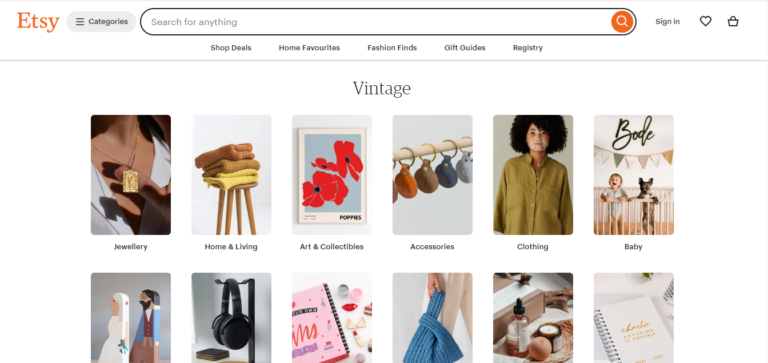
Platforms like Etsy, Amazon Handmade, Shopify, and social commerce channels allow even small makers to sell directly to millions of buyers without opening a physical store.
Customization Is Becoming the Standard
Consumers increasingly want products customized with names, colors, sizes, materials, or designs.
This shift has increased demand for handmade manufacturers and artisan workshops that can produce custom products in small or medium batches.
Consumers Are Willing to Pay More for Craftsmanship
Many buyers see handmade products as higher quality than mass-produced alternatives.
They are often willing to pay a premium for products made by skilled artisans using traditional techniques and better materials.
Sustainability Is Influencing Buying Decisions
Handmade products are often made in smaller batches using locally sourced, recycled, or natural materials.
As consumers become more environmentally conscious, many prefer handmade products over factory-made alternatives with higher environmental impact.
Social Media Helps Small Brands Reach Global Customers
Platforms like Instagram, TikTok, Pinterest, and Facebook allow artisans to showcase their work to millions of potential buyers.
Short-form videos demonstrating craftsmanship and behind-the-scenes production have become powerful marketing tools for handmade businesses like Customcy.
Government and Nonprofit Support for Artisan Communities
Many countries continue to invest in programs that preserve traditional crafts, train artisans, and promote handmade exports.
These initiatives help strengthen local artisan economies while increasing the global visibility of handmade products.
Handmade Market Trends (2026)
Growth drivers explain why the market is expanding. These are the specific shifts happening right now.
1. Marketplaces are redefining what counts as “handmade”
Etsy rewrote its Creativity Standards in 2025, then tightened enforcement further under new CEO Kruti Patel Goyal, who took over the role in January 2026. Items made with computerized tools — laser cutters, sublimation printers — must now use the seller’s own original design. Purchased templates and licensed clipart no longer qualify.
Sellers must also disclose AI use in their listings. Not disclosing it is now an active suspension trigger.
Etsy’s 2024 Transparency Report disclosed roughly 3.5 million spam and reseller accounts banned that year, a ninefold increase over the year before. It’s a direct response to buyer backlash over mass-produced goods, often sourced from Temu or Shein, being listed as handmade.
2. EU product-safety law now applies to individual makers
The EU’s General Product Safety Regulation (GPSR) became fully applicable on December 13, 2024, introducing stricter product safety and traceability requirements for businesses selling consumer products in the EU. Handmade sellers on marketplaces like Etsy and Amazon must now provide additional product safety information and meet compliance requirements when selling to European customers
3. Sellers are spreading across more platforms
Beyond Etsy, artisans are increasingly listing on Amazon Handmade (verified-artisan-only, flat referral fee), niche handmade-only marketplaces like Goimagine and the seller-owned Artisans Cooperative, and self-owned storefronts on Shopify or Big Cartel.
It’s a hedge against any single platform’s policy or fee changes, and it’s especially pronounced in handmade, given how often marketplace authenticity rules have shifted in 2025 and 2026.
4. Livestream selling is closing sales, not just driving discovery
TikTok Shop LIVE and Instagram Live Shopping are increasingly where the sale itself happens, especially for one-of-a-kind or limited-run pieces suited to real-time, scarcity-driven selling.
5. AI is in sellers’ toolkits, and on platforms’ watchlists
There’s a real split here. Etsy permits AI-generated product mockup photos and AI-assisted listing copy, as long as it’s disclosed. But it bans AI-generated designs marketed as original handmade work.
Same technology, two different rules, depending on whether it’s helping a maker run their shop or replacing the making itself.
6. Trade-policy uncertainty is a live variable
The WTO’s 2026 analysis found that 2025’s tariff impact was smaller than initially feared, thanks to a suspension of new US tariffs until August and broad exemptions. But it’s still an open variable for 2026 and beyond, affecting both US sellers importing raw materials and overseas artisans in India, China, and Indonesia exporting finished goods to the US, historically their largest single market.
Handmade Market Restraints
These are the structural headwinds keeping the market’s growth rate in low single digits, rather than the double digits some commercial reports assume.
1. An aging artisan workforce
This shows up independently across three unrelated regions.
In India, UN-cited data shows the number of artisans has fallen roughly 30% over the past 30 years, as younger generations move toward urban service-sector jobs.
In the EU, labor force survey data from Cedefop shows the share of handicraft and printing workers aged 50–64 has risen significantly faster than the all-occupation average, while overall employment in the sector has declined in most years over the past decade.
In the US, a 2026 trades-industry survey found woodworking is the trade expected to be hit hardest by the ongoing skills shortage: 59% cited too few young entrants, and 45.6% cited an aging, retiring workforce.
This caps how fast the supply side of a hand-produced market can grow, no matter how strong demand gets.
2. Rising marketplace fees
Etsy raised its core seller transaction fee from 5% to 6.5% in April 2022, a 30% relative increase. It triggered a week-long seller strike and a petition signed by tens of thousands of sellers.
Add in payment processing fees and Etsy’s Offsite Ads program (mandatory for high-volume sellers, at 12–15% of order value), and effective take rates on the leading handmade marketplace can run well above 20% today.
3. Regulatory compliance costs
The EU’s GPSR, covered above, applies to individual makers with no exemption. Industry compliance guides put the added cost at roughly $200–600 per year for a typical small seller, a cost that scales far more easily for a factory shipping thousands of units than for an artisan shipping dozens.
4. Trust erosion from fake “handmade” listings
The same dynamic driving Etsy’s 2025–2026 policy crackdown is also a genuine market restraint. When buyers can’t tell an authentic handmade listing from a resold, factory-made item, price comparison shifts toward the cheaper factory good. Buyer trust in the “handmade” label erodes across the board, not just for the offending listings.
5. Hand production doesn’t scale like a factory does
By definition, hand production doesn’t benefit from the unit-cost economics of automated manufacturing. A single artisan or small workshop has a hard ceiling on output that no amount of demand-side growth can lift.
This is a big reason brands looking to sell handmade-style products at real volume increasingly work with manufacturers that maintain networks of many artisans, rather than relying on a single workshop. Customcy is one example: it connects businesses with artisan networks across woodworking, stoneworking, and leatherworking to produce custom handmade and machine-made goods at scale.
6. Informal-sector opacity limits access to capital
Because so much handmade production and domestic consumption happens outside formal trade statistics, artisans and small workshops, especially in producer economies like Pakistan, India, Indonesia, and Vietnam, often lack the documented sales history and formal business registration needed to access credit, insurance, or institutional buyers.
The same measurement gap that likely understates the market’s true size (see Growth Driver #6) also limits its ability to formalize and scale.
FAQ: handmade market size and trends
How big is the global handmade market in 2026?
The global handmade market is worth an estimated $1.28 trillion in 2026, according to Customcy’s analysis.
How big is the US handmade market?
The US handmade market is worth an estimated $343 billion in 2026, about 27% of the global market.
Which region has the largest handmade market?
Asia-Pacific, at an estimated $578 billion in 2026, driven by both production volume and domestic consumption that doesn’t show up in trade data.
Which handmade category is the largest?
Home decor, furniture, and woodwork, worth an estimated $347 billion globally in 2026.
What’s the fastest-growing handmade category?
Toys, games, paper, and other novelty goods, projected to grow at a 4.2% CAGR through 2033.
Is the handmade market growing?
Yes, but slowly. This analysis projects annual growth globally through 2033, slower than the 8–10% CAGRs some commercial reports assume, because it’s anchored to real trade-growth data rather than a projected e-commerce boom.
Why do handmade market size estimates vary so much?
Because “handmade” isn’t an official trade or industry classification. No government body publishes a “handmade market size” figure. Every number you’ll see, including this one, is a modeled estimate. Much of the variation comes down to scope: many reports size “handicrafts” specifically and label it “handmade,” which understates the full category.
What’s driving growth in the handmade market?
Mainly mobile e-commerce and direct-to-consumer channels, social commerce and short-form video discovery, demand for customization and sustainability, and government artisan-support programs in producer economies like India.
About this report
We compiled this analysis using publicly available trade and government data, including the International Trade Centre, UNCTAD, the World Trade Organization, India’s Export Promotion Council for Handicrafts, and SEC filings from Etsy, Inc., along with labor market data from Cedefop and independent trades-industry research. You can find a full breakdown of the methodology and calculations behind these figures here.
Sources
Primary and official sources
- International Trade Centre (ITC), “Crafts” — https://www.intracen.org/our-work/topics/goods-and-services/crafts
- UNCTAD, Creative Economy Outlook 2024 — https://unctad.org/system/files/official-document/ditctsce2024d2_en.pdf
- UNCTAD, Creative Economy Outlook 2024, Annex I — https://unctad.org/system/files/official-document/ditctsce2024d2_annex1_en.pdf
- WTO, Global Trade Outlook and Statistics, March 2026 — https://www.wto.org/english/res_e/publications_e/gtos0326_e.htm
- WTO news release, “Middle East conflict weighs further on slowing trade outlook” — https://www.wto.org/english/news_e/news26_e/stat_19mar26_329_e.htm
- WTO Blog, “AI investment and Middle East conflict shape outlook for global trade” — https://www.wto.org/english/news_e/news26_e/blgrs_20mar26_332_e.htm
- Etsy, Inc., Form 10-K for FY2025 (SEC EDGAR) — https://investors.etsy.com/sec-filings/all-sec-filings/content/0001370637-26-000019/etsy-20251231.htm
- Etsy, Inc., Q4/FY2025 results press release — https://investors.etsy.com/news-events/press-releases/detail/218/etsy-inc-reports-fourth-quarter-and-full-year-2025-results
- Etsy, Inc., Form 10-K for FY2022 (SEC EDGAR) — https://www.sec.gov/Archives/edgar/data/1370637/000137063723000017/etsy-20221231.htm
- India Brand Equity Foundation (IBEF), citing EPCH data — https://www.ibef.org/blogs/handicraft-in-india-rising-through-digital-expansion-and-global-demand
- India Brand Equity Foundation (IBEF), Indian Handicrafts Industry overview — https://www.ibef.org/exports/handicrafts-industry-india
- Export Promotion Council for Handicrafts (EPCH), Government of India — https://epch.in/
- EU General Product Safety Regulation, Regulation (EU) 2023/988, summarized via Craftybase — https://craftybase.com/blog/what-is-gpsr
- Cedefop, “Handicraft and printing workers: skills opportunities and challenges” — https://www.cedefop.europa.eu/en/data-insights/handicraft-and-printing-workers-skills-opportunities-and-challenges-2023-update